Nodes
Overview
Nodes are the building blocks of every workflow in Floyo. Each node performs a specific task, and you connect them together to create complete AI generation pipelines.
What Are Nodes?
Each node does a specific job: loading a model, generating an image, adjusting a parameter, or passing data along. You connect nodes together to define how your workflow runs, step by step.
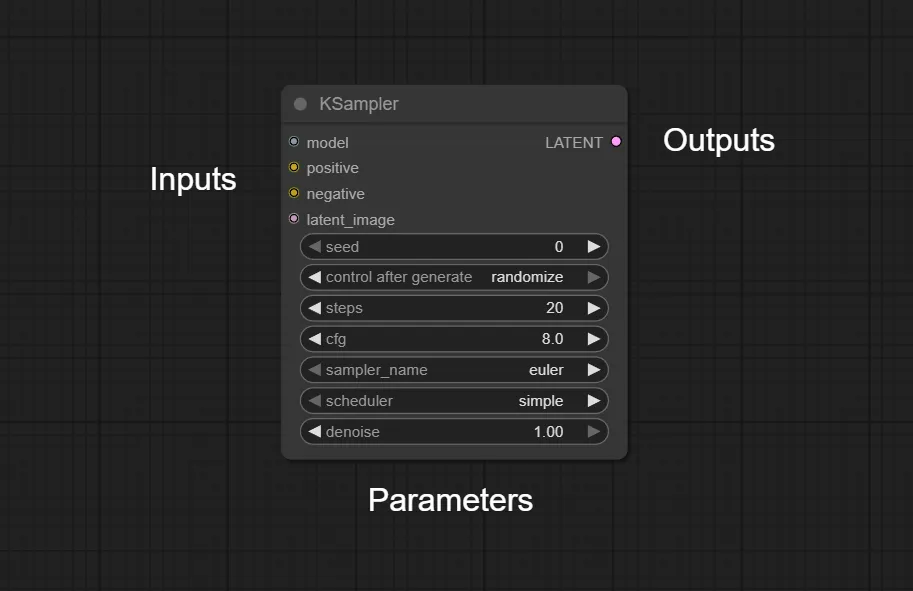
Component | Location | Description |
|---|---|---|
Inputs | Left side | Where data enters the node |
Outputs | Right side | Where processed data exits |
Parameters | Node body | Settings you can adjust |
Some nodes are interactive, letting you upload a file or view a preview directly in the workflow.
Node States
Nodes update their status as the workflow runs. You can see the current state by the colored border around each node.
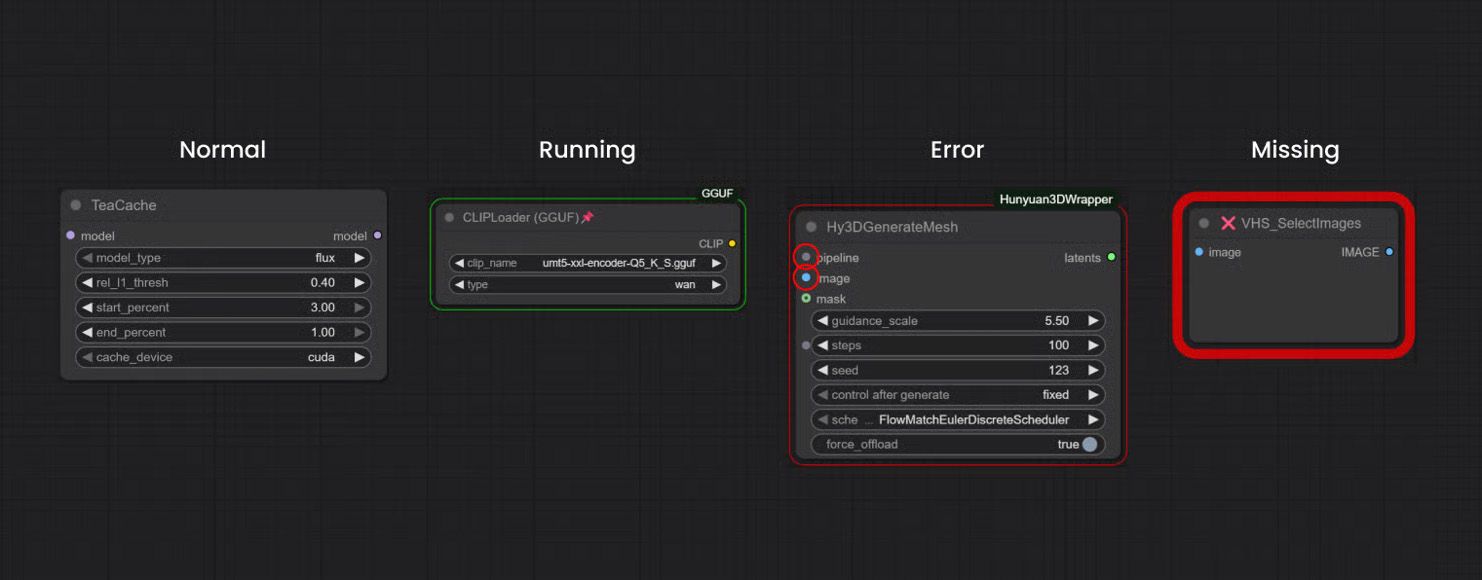
State | Border Color | Description |
|---|---|---|
Normal | Default | Node is idle, ready to process |
Running | Green | Node is currently processing |
Error | Red | Something went wrong (missing input or bad connection) |
Missing | Red outline | Node is not installed or has missing dependencies |
Connections
To build a workflow, you connect the output of one node to the input of another. This tells Floyo how data should flow through your workflow.

Making Connections
- Click on an output slot (right side of a node)
- Drag to an input slot (left side of another node)
- Release to create the connection
Only compatible inputs and outputs can connect. The color tells you whether two nodes can connect. If they're not compatible, the connection won't work.
Connections are drawn as lines between nodes, giving you a clear visual map of how your workflow is structured.
Connection Color Codes
Every connection between nodes has a color that indicates what kind of data is flowing through the workflow. Learning the colors helps you instantly read and understand any workflow.
Color | Data Type | Description |
|---|---|---|
Yellow | CLIP | Converts your text into "AI language" that the model can understand |
Red | VAE | Acts like a portal between the AI world and visible image; decodes/encodes between pixels and latent space |
Blue | RGB Image | Standard images in pixel space; what you see when you export or preview |
Pink | Latent Space | Images in their compressed "AI-native" form; this is where the magic happens |
Orange | Conditioning | Control data like pose, depth maps, or segmentation; guides generation without changing your prompt |
Green | String | Basic text inputs like filenames, folder paths, or simple values |
Purple | AI Model | Your actual model file: diffusion models, checkpoints, LoRAs, or other trained weights |
Teal | ControlNet | Used specifically for sending ControlNet data through your workflow |
Tips & Best Practices
- Follow the flow: Arrange nodes left-to-right following the data flow for easier reading
- Check colors: Use connection colors to quickly understand what data is moving where
- Watch for red: Red borders or outlines indicate errors or missing nodes that need attention
- Hover for info: Hover over any node to see tooltips about its inputs and outputs